
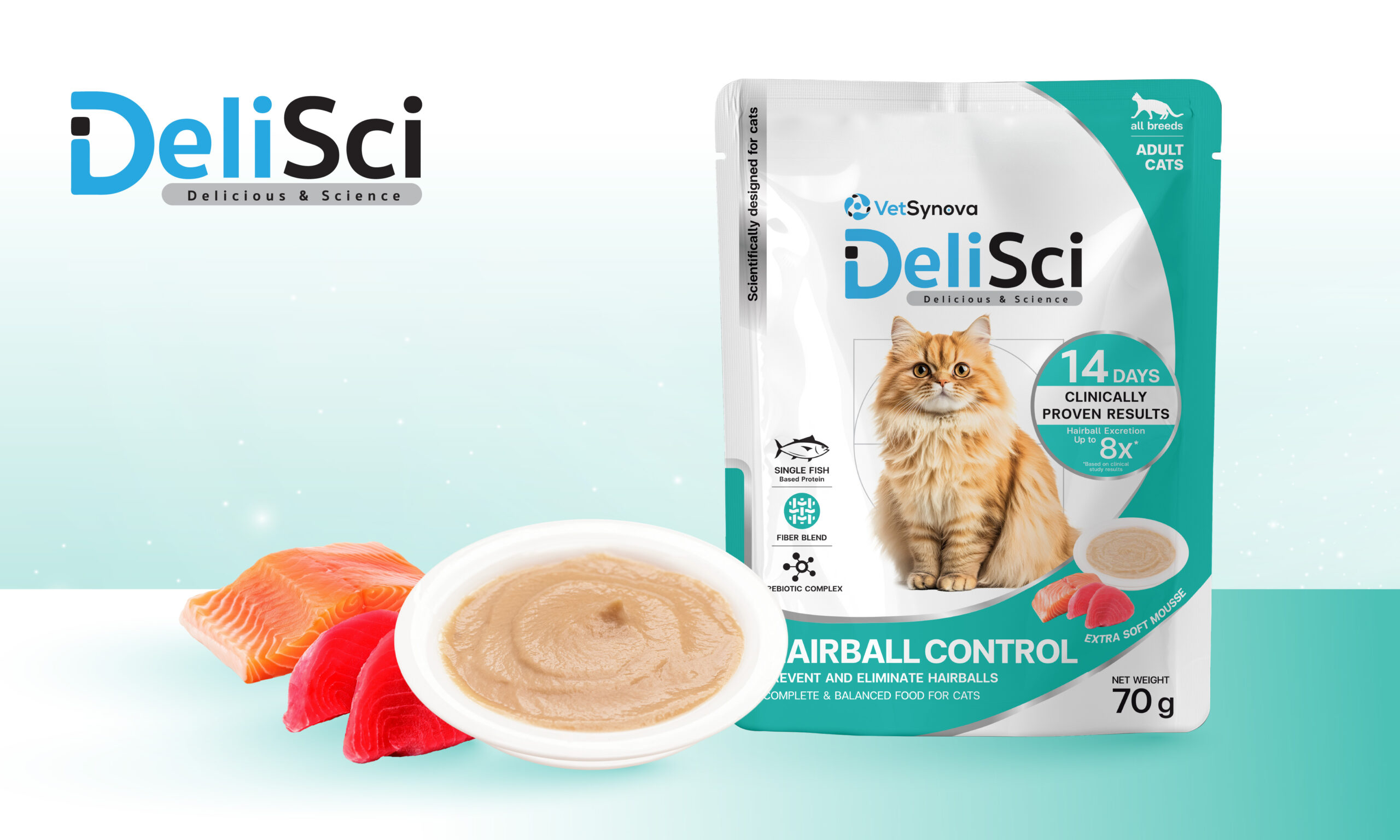
Cats spend a substantial amount of time grooming each day, inadvertently ingesting loose hair in the process. Although most ingested hair passes through the gastrointestinal tract, accumulated hair may form a hairball, also known as a trichobezoar. This may lead to retching, vomiting of hairballs, reduced appetite, or abdominal discomfort.
However, ingested hair can also be eliminated through another route: passage through the gastrointestinal tract and excretion in the feces. This is one of the key principles behind DeliSci Hairball Control, which incorporates dietary fiber to help promote the fecal excretion of ingested hair and reduce the potential for hairball accumulation within the gastrointestinal tract.
How does dietary fiber help manage hairballs?
Dietary fiber does not dissolve or digest hair. Instead, it helps support the passage of contents through the gastrointestinal tract. Insoluble fiber, such as cellulose, can increase fecal bulk and facilitate intestinal transit. This helps carry ingested hair through the intestines along with other intestinal contents, promoting its elimination in the feces rather than allowing it to accumulate and form hairballs.
This approach is also supported by an article published in the Journal of the American Veterinary Medical Association (JAVMA), which identifies increased dietary fiber intake as one of the principal nutritional recommendations for managing hairballs in cats.
Accordingly, DeliSci Hairball Control is formulated with a Natural Fiber Blend to help manage ingested hair by supporting its fecal excretion, one of the body’s natural routes for eliminating swallowed hair.
Does DeliSci Hairball Control help increase fecal hair excretion?
A study in cats evaluated whether DeliSci Hairball Control could increase fecal hair excretion by comparing the amount of hair recovered from the feces of cats receiving DeliSci Hairball Control with that of cats receiving a control diet.
The results showed that, after 14 days of continuous feeding, the mean amount of hair excreted in the feces of cats receiving DeliSci Hairball Control was approximately eight times that observed in cats receiving the control diet.
These findings indicate that, under the conditions of the study, DeliSci Hairball Control increased the fecal elimination of ingested hair. Promoting this route of elimination may help limit hair accumulation within the gastrointestinal tract and support hairball management.
DeliSci Hairball Control therefore offers a nutritional option to help manage hairballs in cats. Its Natural Fiber Blend supports the passage of ingested hair through the gastrointestinal tract and its natural elimination in the feces. In the study, cats receiving DeliSci Hairball Control for 14 days excreted, on average, approximately eight times as much hair in their feces as cats receiving the control diet.

Leave A Comment